







Elementary Galois Theory: A Constructive Approach
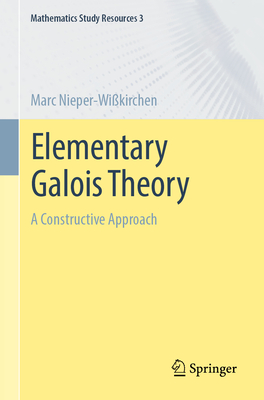
Elementary Galois Theory: A Constructive Approach
Why is the squaring of the circle, why is the division of angles with compass and ruler impossible? Why are there general solution formulas for polynomial equations of degree 2, 3 and 4, but not for degree 5 or higher? This textbook deals with such classical questions in an elementary way in the context of Galois theory. It thus provides a classical introduction and at the same time deals with applications. The point of view of a constructive mathematician is consistently adopted: To prove the existence of a mathematical object, an algorithmic construction of that object is always given. Some statements are therefore formulated somewhat more cautiously than is classically customary; some proofs are more elaborately conducted, but are clearer and more comprehensible. Abstract theories and definitions are derived from concrete problems and solutions and can thus be better understood and appreciated. The material in this volume can be covered in a one-semester lecture on algebra right at the beginning of mathematics studies and is equally suitable for first-year students at the Bachelor's level and for teachers. The central statements are already summarised and concisely presented within the text, so the reader is encouraged to pause and reflect and can repeat content in a targeted manner. In addition, there is a short summary at the end of each chapter, with which the essential arguments can be comprehended step by step, as well as numerous exercises with an increasing degree of difficulty.
Why is the squaring of the circle, why is the division of angles with compass and ruler impossible? Why are there general solution formulas for polynomial equations of degree 2, 3 and 4, but not for degree 5 or higher? This textbook deals with such classical questions in an elementary way in the context of Galois theory. It thus provides a classical introduction and at the same time deals with applications. The point of view of a constructive mathematician is consistently adopted: To prove the existence of a mathematical object, an algorithmic construction of that object is always given. Some statements are therefore formulated somewhat more cautiously than is classically customary; some proofs are more elaborately conducted, but are clearer and more comprehensible. Abstract theories and definitions are derived from concrete problems and solutions and can thus be better understood and appreciated. The material in this volume can be covered in a one-semester lectur
Why is the squaring of the circle, why is the division of angles with compass and ruler impossible? Why are there general solution formulas for polynomial equations of degree 2, 3 and 4, but not for degree 5 or higher? This textbook deals with such classical questions in an elementary way in the context of Galois theory. It thus provides a classical introduction and at the same time deals with applications. The point of view of a constructive mathematician is consistently adopted: To prove the existence of a mathematical object, an algorithmic construction of that object is always given. Some statements are therefore formulated somewhat more cautiously than is classically customary; some proofs are more elaborately conducted, but are clearer and more comprehensible. Abstract theories and definitions are derived from concrete problems and solutions and can thus be better understood and appreciated. The material in this volume can be covered in a one-semester lectur
PRP: 377.92 Lei

Acesta este Prețul Recomandat de Producător. Prețul de vânzare al produsului este afișat mai jos.
340.13Lei
340.13Lei
377.92 LeiPrimești 340 puncte
Livrare in 2-4 saptamani
Descrierea produsului
Why is the squaring of the circle, why is the division of angles with compass and ruler impossible? Why are there general solution formulas for polynomial equations of degree 2, 3 and 4, but not for degree 5 or higher? This textbook deals with such classical questions in an elementary way in the context of Galois theory. It thus provides a classical introduction and at the same time deals with applications. The point of view of a constructive mathematician is consistently adopted: To prove the existence of a mathematical object, an algorithmic construction of that object is always given. Some statements are therefore formulated somewhat more cautiously than is classically customary; some proofs are more elaborately conducted, but are clearer and more comprehensible. Abstract theories and definitions are derived from concrete problems and solutions and can thus be better understood and appreciated. The material in this volume can be covered in a one-semester lecture on algebra right at the beginning of mathematics studies and is equally suitable for first-year students at the Bachelor's level and for teachers. The central statements are already summarised and concisely presented within the text, so the reader is encouraged to pause and reflect and can repeat content in a targeted manner. In addition, there is a short summary at the end of each chapter, with which the essential arguments can be comprehended step by step, as well as numerous exercises with an increasing degree of difficulty.
Why is the squaring of the circle, why is the division of angles with compass and ruler impossible? Why are there general solution formulas for polynomial equations of degree 2, 3 and 4, but not for degree 5 or higher? This textbook deals with such classical questions in an elementary way in the context of Galois theory. It thus provides a classical introduction and at the same time deals with applications. The point of view of a constructive mathematician is consistently adopted: To prove the existence of a mathematical object, an algorithmic construction of that object is always given. Some statements are therefore formulated somewhat more cautiously than is classically customary; some proofs are more elaborately conducted, but are clearer and more comprehensible. Abstract theories and definitions are derived from concrete problems and solutions and can thus be better understood and appreciated. The material in this volume can be covered in a one-semester lectur
Why is the squaring of the circle, why is the division of angles with compass and ruler impossible? Why are there general solution formulas for polynomial equations of degree 2, 3 and 4, but not for degree 5 or higher? This textbook deals with such classical questions in an elementary way in the context of Galois theory. It thus provides a classical introduction and at the same time deals with applications. The point of view of a constructive mathematician is consistently adopted: To prove the existence of a mathematical object, an algorithmic construction of that object is always given. Some statements are therefore formulated somewhat more cautiously than is classically customary; some proofs are more elaborately conducted, but are clearer and more comprehensible. Abstract theories and definitions are derived from concrete problems and solutions and can thus be better understood and appreciated. The material in this volume can be covered in a one-semester lectur
Detaliile produsului



