





settler
settler
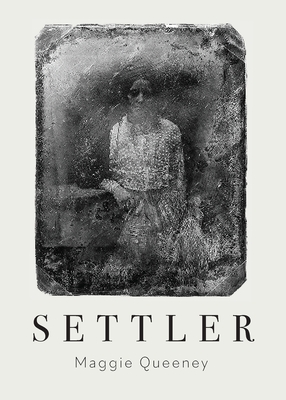
These fourteen-line poems give voice to the individual and collective experiences of women. They are windows into a stark otherworld, one filled with the raw materials of experience: sex, birth, cloth, pain. Spare and strange beauty marks the lives and worlds of these women, defined by their struggle for survival in the physical and psychological captivity of the domestic realm. The speaker moves between the singular and plural, sounding out the overlapping experiences of women as both subject and object of the domination inherent in settler colonialism.
To live inside Maggie Queeney's settler is to be unraveled, bewitched, drawn back to the wonders of words and what we invent with them. In the words of Diane Seuss, 'There is something to be said for a boundary. There is also something to be said for an unbinding.' Through the poems' collective speaker, the reader is implied and thus invited to turn and return with Queeney, backward toward reverberations of grief and the genesis of language, forward toward birth and reinvention, 'The scream of the new voice / invading the old room.' These are holy sonnets for a new generation--Queeney reimagines form, challenging staid ideas of confinement, to gaze toward an edgy horizon, marveling at the sanctity of making, of language, of the human body, of pleasure and pain, of animal and earth.--Jenny MolbergPoetry.
To live inside Maggie Queeney's settler is to be unraveled, bewitched, drawn back to the wonders of words and what we invent with them. In the words of Diane Seuss, 'There is something to be said for a boundary. There is also something to be said for an unbinding.' Through the poems' collective speaker, the reader is implied and thus invited to turn and return with Queeney, backward toward reverberations of grief and the genesis of language, forward toward birth and reinvention, 'The scream of the new voice / invading the old room.' These are holy sonnets for a new generation--Queeney reimagines form, challenging staid ideas of confinement, to gaze toward an edgy horizon, marveling at the sanctity of making, of language, of the human body, of pleasure and pain, of animal and earth.--Jenny MolbergPoetry.
To live inside Maggie Queeney's settler is to be unraveled, bewitched, drawn back to the wonders of words and what we invent with them. In the words of Diane Seuss, 'There is something to be said for a boundary. There is also something to be said for an unbinding.' Through the poems' collective
PRP: 98.87 Lei

Acesta este Prețul Recomandat de Producător. Prețul de vânzare al produsului este afișat mai jos.
88.98Lei
88.98Lei
98.87 LeiPrimești 88 puncte
Indisponibil
Descrierea produsului
These fourteen-line poems give voice to the individual and collective experiences of women. They are windows into a stark otherworld, one filled with the raw materials of experience: sex, birth, cloth, pain. Spare and strange beauty marks the lives and worlds of these women, defined by their struggle for survival in the physical and psychological captivity of the domestic realm. The speaker moves between the singular and plural, sounding out the overlapping experiences of women as both subject and object of the domination inherent in settler colonialism.
To live inside Maggie Queeney's settler is to be unraveled, bewitched, drawn back to the wonders of words and what we invent with them. In the words of Diane Seuss, 'There is something to be said for a boundary. There is also something to be said for an unbinding.' Through the poems' collective speaker, the reader is implied and thus invited to turn and return with Queeney, backward toward reverberations of grief and the genesis of language, forward toward birth and reinvention, 'The scream of the new voice / invading the old room.' These are holy sonnets for a new generation--Queeney reimagines form, challenging staid ideas of confinement, to gaze toward an edgy horizon, marveling at the sanctity of making, of language, of the human body, of pleasure and pain, of animal and earth.--Jenny MolbergPoetry.
To live inside Maggie Queeney's settler is to be unraveled, bewitched, drawn back to the wonders of words and what we invent with them. In the words of Diane Seuss, 'There is something to be said for a boundary. There is also something to be said for an unbinding.' Through the poems' collective speaker, the reader is implied and thus invited to turn and return with Queeney, backward toward reverberations of grief and the genesis of language, forward toward birth and reinvention, 'The scream of the new voice / invading the old room.' These are holy sonnets for a new generation--Queeney reimagines form, challenging staid ideas of confinement, to gaze toward an edgy horizon, marveling at the sanctity of making, of language, of the human body, of pleasure and pain, of animal and earth.--Jenny MolbergPoetry.
To live inside Maggie Queeney's settler is to be unraveled, bewitched, drawn back to the wonders of words and what we invent with them. In the words of Diane Seuss, 'There is something to be said for a boundary. There is also something to be said for an unbinding.' Through the poems' collective
Detaliile produsului



