





Stalingrad Battle Atlas: volume II
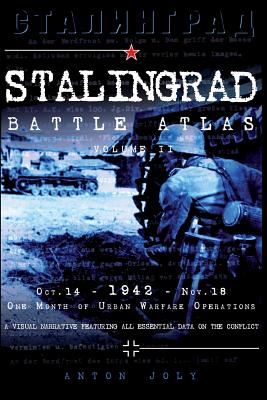
Stalingrad Battle Atlas: volume II
The New 2017 Revised Edition has been awarded the APMC Cultural Price at the Salon de l'Histoire in Paris. "We realized that the decisive battle had come and if we can survive it the Germans were unlikely to muster such powerful forces again."
Thus wrote Lieutenant-General Vasily Chuikov, 62nd Army's Commander, about 14 October 1942. As hundreds of tons of steel where hurled against the Soviet defenders, the Germans unleashed a critical onslaught in what they perceived as their D-day for Stalingrad. This same day Hitler issued the winter standby directive to his troops on the eastern front. It read: "This year's summer and fall campaign, excepting the operations currently under way and several local offensives still contemplated, has been concluded." As for the "operations currently under way" 6th Army was ordered not only to continue, but also to strengthen its offensive. Although badly depleted for the most part, the divisions mustered by both sides in the industrial district of the city still embodied a considerable fighting potential. With regard to density, seldom in the history of wars such a small territory was contested by such a quantity of manpower, artillery and aircraft. After the equivalent of a full month of fighting within the city, the culminating point was about to be reached. Towards mid- October, after having reorganized of his attacking forces, General Paulus moved the most able formations into line, expecting the entire front to collapse in the northern sector of Stalingrad, then to finish off 62nd Army's truncated remnants with an enveloping maneuver along the Volga, as was his intent from the beginning. The second volume of the Stalingrad Battle Atlas book series covers another 35 days of fighting inside the city. It relies upon hundreds of wartime reports and recently released archival documents translated by the author. The main sources consist in German 6th Army and Soviet 62nd Army War Diaries, along with data on their units, corps, divisions and regiments. Based on the precise information these documents provide, this volume features specifically designed maps with unit positions for each day of active operations. Synthesizing an extremely wide range of documents and information sources, this chronological atlas seeks to reach the maximal degree of precision in describing historical reality, rendering it through a standardized set of instruments: timeline, orders of battle, unit strength returns, tactical and
PRP: 177.86 Lei

Acesta este Prețul Recomandat de Producător. Prețul de vânzare al produsului este afișat mai jos.
142.29Lei
142.29Lei
177.86 LeiPrimești 142 puncte
Livrare in 2-4 saptamani
Descrierea produsului
The New 2017 Revised Edition has been awarded the APMC Cultural Price at the Salon de l'Histoire in Paris. "We realized that the decisive battle had come and if we can survive it the Germans were unlikely to muster such powerful forces again."
Thus wrote Lieutenant-General Vasily Chuikov, 62nd Army's Commander, about 14 October 1942. As hundreds of tons of steel where hurled against the Soviet defenders, the Germans unleashed a critical onslaught in what they perceived as their D-day for Stalingrad. This same day Hitler issued the winter standby directive to his troops on the eastern front. It read: "This year's summer and fall campaign, excepting the operations currently under way and several local offensives still contemplated, has been concluded." As for the "operations currently under way" 6th Army was ordered not only to continue, but also to strengthen its offensive. Although badly depleted for the most part, the divisions mustered by both sides in the industrial district of the city still embodied a considerable fighting potential. With regard to density, seldom in the history of wars such a small territory was contested by such a quantity of manpower, artillery and aircraft. After the equivalent of a full month of fighting within the city, the culminating point was about to be reached. Towards mid- October, after having reorganized of his attacking forces, General Paulus moved the most able formations into line, expecting the entire front to collapse in the northern sector of Stalingrad, then to finish off 62nd Army's truncated remnants with an enveloping maneuver along the Volga, as was his intent from the beginning. The second volume of the Stalingrad Battle Atlas book series covers another 35 days of fighting inside the city. It relies upon hundreds of wartime reports and recently released archival documents translated by the author. The main sources consist in German 6th Army and Soviet 62nd Army War Diaries, along with data on their units, corps, divisions and regiments. Based on the precise information these documents provide, this volume features specifically designed maps with unit positions for each day of active operations. Synthesizing an extremely wide range of documents and information sources, this chronological atlas seeks to reach the maximal degree of precision in describing historical reality, rendering it through a standardized set of instruments: timeline, orders of battle, unit strength returns, tactical and
Detaliile produsului



