





The Return of Don Quixote
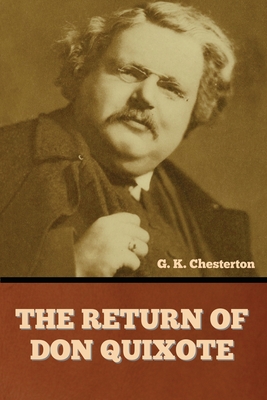
The Return of Don Quixote
Gilbert Keith Chesterton KC*SG (29 May 1874 - 14 June 1936) was an English writer, philosopher, Christian apologist, and literary and art critic. He has been referred to as the "prince of paradox". Of his writing style, Time observed: "Whenever possible, Chesterton made his points with popular sayings, proverbs, allegories-first carefully turning them inside out."
Chesterton created the fictional priest-detective Father Brown, and wrote on apologetics. Even some of those who disagree with him have recognised the wide appeal of such works as Orthodoxy and The Everlasting Man. Chesterton routinely referred to himself as an "orthodox" Christian, and came to identify this position more and more with Catholicism, eventually converting to Roman Catholicism from high church Anglicanism. Biographers have identified him as a successor to such Victorian authors as Matthew Arnold, Thomas Carlyle, John Henry Newman and John Ruskin.
Chesterton wrote around 80 books, several hundred poems, some 200 short stories, 4,000 essays (mostly newspaper columns), and several plays. He was a literary and social critic, historian, playwright, novelist, Catholic theologian and apologist, debater, and mystery writer. He was a columnist for the Daily News, The Illustrated London News, and his own paper, G. K.'s Weekly; he also wrote articles for the Encyclopedia Britannica, including the entry on Charles Dickens and part of the entry on Humour in the 14th edition (1929). His best-known character is the priest-detective Father Brown, who appeared only in short stories, while The Man Who Was Thursday is arguably his best-known novel. He was a convinced Christian long before he was received into the Catholic Church, and Christian themes and symbolism appear in much of his writing. In the United States, his writings on distributism were popularised through The American Review, published by Seward Collins in New York.
Of his nonfiction, Charles Dickens: A Critical Study (1906) has received some of the broadest-based praise. According to Ian Ker (The Catholic Revival in English Literature, 1845-1961, 2003), "In Chesterton's eyes Dickens belongs to Merry, not Puritan, England"; Ker treats Chesterton's thought in chapter 4 of that book as largely growing out of his true appreciation of Dickens, a somewhat shop-soiled property in the view of other literary opinions of the time. The biography was largely responsible for creating a popular revival for Dickens's work as well as a ser
PRP: 127.13 Lei

Acesta este Prețul Recomandat de Producător. Prețul de vânzare al produsului este afișat mai jos.
101.70Lei
101.70Lei
127.13 LeiPrimești 101 puncte
Livrare in 2-4 saptamani
Descrierea produsului
Gilbert Keith Chesterton KC*SG (29 May 1874 - 14 June 1936) was an English writer, philosopher, Christian apologist, and literary and art critic. He has been referred to as the "prince of paradox". Of his writing style, Time observed: "Whenever possible, Chesterton made his points with popular sayings, proverbs, allegories-first carefully turning them inside out."
Chesterton created the fictional priest-detective Father Brown, and wrote on apologetics. Even some of those who disagree with him have recognised the wide appeal of such works as Orthodoxy and The Everlasting Man. Chesterton routinely referred to himself as an "orthodox" Christian, and came to identify this position more and more with Catholicism, eventually converting to Roman Catholicism from high church Anglicanism. Biographers have identified him as a successor to such Victorian authors as Matthew Arnold, Thomas Carlyle, John Henry Newman and John Ruskin.
Chesterton wrote around 80 books, several hundred poems, some 200 short stories, 4,000 essays (mostly newspaper columns), and several plays. He was a literary and social critic, historian, playwright, novelist, Catholic theologian and apologist, debater, and mystery writer. He was a columnist for the Daily News, The Illustrated London News, and his own paper, G. K.'s Weekly; he also wrote articles for the Encyclopedia Britannica, including the entry on Charles Dickens and part of the entry on Humour in the 14th edition (1929). His best-known character is the priest-detective Father Brown, who appeared only in short stories, while The Man Who Was Thursday is arguably his best-known novel. He was a convinced Christian long before he was received into the Catholic Church, and Christian themes and symbolism appear in much of his writing. In the United States, his writings on distributism were popularised through The American Review, published by Seward Collins in New York.
Of his nonfiction, Charles Dickens: A Critical Study (1906) has received some of the broadest-based praise. According to Ian Ker (The Catholic Revival in English Literature, 1845-1961, 2003), "In Chesterton's eyes Dickens belongs to Merry, not Puritan, England"; Ker treats Chesterton's thought in chapter 4 of that book as largely growing out of his true appreciation of Dickens, a somewhat shop-soiled property in the view of other literary opinions of the time. The biography was largely responsible for creating a popular revival for Dickens's work as well as a ser
Detaliile produsului



